 Panacea Bio ChemProcess Telemetry · Lyophilisation landmarks
Cryoflare Record
Updated Jul 2026
Updated Jul 2026
Panacea Bio ChemProcess Telemetry · Lyophilisation landmarksDuring lyophilisation a product emits two sharp, self-announcing temperature spikes — one up during the freeze, one down during sublimation. Panacea Bio Chem records both, reads them as landmarks, and uses them to coordinate TgShift governance and many processes across the Lyochrysalis platform together with LyoLevit.
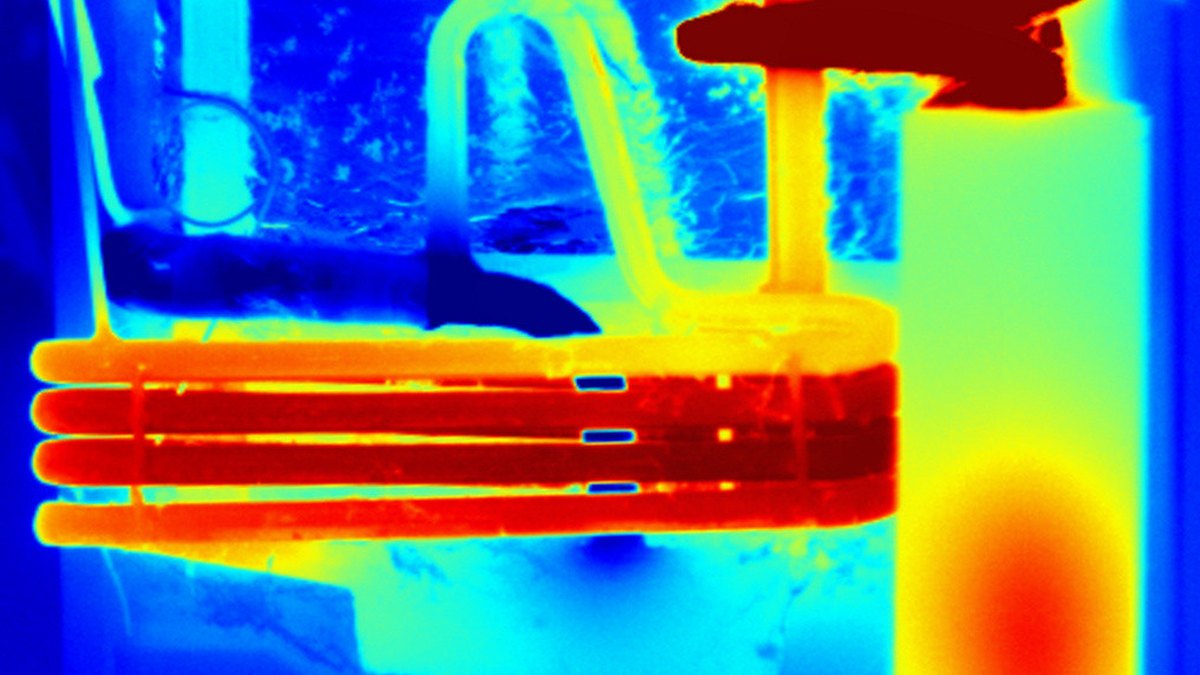
Cryoflare is the name Panacea Bio Chem gives to the pair of temperature-spike landmarks a product declares during freeze-drying. The Cryosurge is an upward spike during the deep freeze: after the liquid supercools, ice nucleates, the peptide or API liquid crystallises and vitrifies, and the latent heat of crystallisation is released — the product temperature jumps up vertiginously, sometimes by about 12 °C. The Cryoflare is a downward spike during sublimation: under high vacuum, turning ice straight to vapour is endothermic, so the product-surface temperature drops just as vertiginously. Neither spike is noise. Each is a precise, no-cost signal the product itself sends at a decisive instant — and by recording both, Panacea reads the run by what the material is truly doing, and coordinates TgShift™ governance and other processes across Lyochrysalis™ and LyoLevit™ in step with them.
Most process control watches the set points a machine is told to hold. Cryoflare watches something more honest: the two moments where the product itself overrides the set point and moves on its own — sharply, and for good physical reasons. Plot product temperature against time through a freeze-dry and two features stand out from the smooth ramps: a fast jump upward while everything around it is still getting colder, and later a fast plunge downward just as drying begins. The first is the Cryosurge; the second is the Cryoflare. Together they are the Cryoflare: the map's two fixed stars.
A set point is what you asked the process to do. A spike is what the material chose to do — and that is the more useful thing to listen to.
Cool a clean solution slowly and it does not freeze the instant it passes 0 °C. It supercools1 — sliding several degrees below its freezing point while still liquid, waiting for a nucleus. When one finally forms, ice grows explosively through the supercooled liquid, and here is the surprise: freezing releases energy. The latent heat of crystallisation (the same enthalpy of fusion2 you would have to add to melt the ice back) pours out as the ordered crystal locks together. That released heat warms the product from within, so its temperature surges upward — vertiginously, sometimes by about 12 °C — snapping back up toward its equilibrium freezing temperature before the deep cold reasserts itself.
It is a beautiful, self-announcing event: the exact instant the liquid becomes a solid, the product tells you by getting warmer. In a peptide or API formulation, that same moment is when the freeze-concentrate around the ice vitrifies toward a glass — the structure the whole cake will inherit. The Cryosurge is therefore not a nuisance to be smoothed away; it is the timestamp of crystallisation itself. Its full physics — and why it is a gift rather than a glitch — is the subject of the companion page, cryosurgepoint.com →.

Primary drying is the reverse bargain. In lyophilisation the ice does not melt; it sublimates3 — passing directly from solid to vapour under high vacuum. And sublimation is endothermic: to break free of the crystal, each molecule must absorb its latent heat of sublimation2. It takes that heat from the only place it can — the cake it is leaving — so the product-surface temperature drops vertiginously, sometimes by about 12 °C. This is the same physics that makes sweat cool skin and a wetted finger feel cold in a breeze, only sharper: sublimative and evaporative cooling4 under vacuum. That downward plunge is the Cryoflare.
Read as a landmark, the Cryoflare is a benefit: it announces, precisely and for free, the moment sublimation truly begins and how fast the drying front is pulling heat. Understood and coordinated, that same self-cooling keeps the drying gentle and the product cold where it needs to be. The honest engineering reason to respect it is simple — a Cryoflare that is not read and coordinated can pull a surface far below its surroundings fast enough to stress the cake, and an unmanaged thermal-shock5 gradient can crack the delicate Lyoprester™ cakes and cartridges. Recording the point is exactly how Panacea turns that sharp edge into a steering signal instead of a stressor.
Panacea Bio Chem records both spike-points and treats them as control landmarks. A landmark is more than a number on a chart: it is a fixed, physically-meaningful event that the rest of the cycle can be referenced against. The Cryosurge landmark fixes the true moment of crystallisation and vitrification; the Cryoflare landmark fixes the true onset and pace of sublimation. With those two points located for a given run, the platform can coordinate what happens next against the product's own physics rather than against a fixed clock — arming and pacing TgShift™ governance so the cake sits just under its raised glass-transition ceiling, and cueing processes across Lyochrysalis™ and LyoLevit™ to match. The whole record is kept live by the S3Pulse™ biointegrity engine →.
| Landmark | Cryosurge | Cryoflare |
|---|---|---|
| Stage | Freeze (ultra-low temperature) | Sublimation (primary drying, high vacuum) |
| Direction | ↑ spike up | ↓ spike down |
| Thermodynamics | Exothermic — latent heat of crystallisation released | Endothermic — latent heat of sublimation absorbed |
| Trigger | Supercooling → nucleation → crystallisation & vitrification | Ice → vapour under vacuum (sublimative cooling) |
| Typical move | up to ~12 °C, vertiginous | down to ~12 °C, vertiginous |
| What it marks | The instant the liquid becomes a glassy solid | The onset & pace of drying — and the stress to manage |
| Read as | Timestamp for arming TgShift & the freeze schedule | Cue for gentle, coordinated sublimation across the platform |
Cryoflare is the sensing idea that lets the rest of the platform act in time. It is one facet of Panacea's wider lyophilisation work, and it earns its keep by feeding the technologies around it:
This section describes an active research direction, stated truthfully as ongoing. No efficacy, dose, outcome or health benefit is claimed; the specific parameters stay with the programme.
Because both spikes are free, self-generated signals of decisive events, listening to them pays off wherever a freeze-dry is delicate, valuable or hard to reproduce:
These fields are offered as a map of scientific and process opportunity and future research direction, not as indications or advice.
What is Cryoflare?
Panacea Bio Chem's coordination concept for the two temperature-spike
landmarks of a freeze-dry: the Cryosurge (an up-spike during the freeze) and the Cryoflare (a
down-spike during sublimation). Both are recorded and used to coordinate TgShift governance and processes
across Lyochrysalis and LyoLevit. Conceived by Bogdan Dicoias. Nothing here is medical advice.
What is the Cryosurge?
An upward temperature spike during the freeze. After the liquid
supercools, ice nucleates and the peptide/API liquid crystallises and vitrifies, releasing the latent heat
of crystallisation — so the product temperature jumps up vertiginously, sometimes by about 12 °C,
toward its equilibrium freezing temperature.
What is the Cryoflare?
A downward temperature spike during sublimation. Under vacuum, turning
ice to vapour absorbs latent heat (endothermic), so the product surface cools vertiginously — sublimative,
evaporative cooling. Read and coordinated it is a precise landmark; left unmanaged, a cryoflare can crack
the cakes and cartridges through thermal shock.
Why record the two spike-points?
Each is a self-announcing, no-cost signal of a decisive
physical event, so together they let the platform coordinate TgShift, Lyochrysalis and LyoLevit against the
product's real physics. The exact thresholds, cadence and coordination algorithm are proprietary to
Bogdan Dicoias.
What are peptide oxidation products?
Oxidation changes susceptible residues or other parts of a peptide through reaction with oxygen or oxidizing species. Methionine, cysteine and tryptophan are commonly oxidation-sensitive. Oxidation can alter mass, conformation, potency or aggregation behaviour and should be considered in formulation and storage. — sources: Sigma-Aldrich — Peptide handling and storage guidelines, PubMed — Stability of therapeutic peptides in aqueous solutions
What is peptide deamidation?
Deamidation is a chemical degradation pathway in which residues such as asparagine or glutamine can be converted to related acidic products. Its rate depends strongly on sequence, pH, temperature and formulation. Deamidation can alter charge and sometimes biological behaviour. — sources: PubMed — Stability of therapeutic peptides in aqueous solutions, Sigma-Aldrich — Peptide handling and storage guidelines
Which amino acids make peptides more prone to oxidation?
Methionine, cysteine and tryptophan are commonly highlighted as oxidation-sensitive residues. Oxidation rate still depends on local sequence, oxygen exposure, light, metals, pH and formulation. Sequence inspection can therefore identify risk, but stability testing is needed to quantify it. — sources: Sigma-Aldrich — Peptide handling and storage guidelines, PubMed — Stability of therapeutic peptides in aqueous solutions
Why do peptides aggregate?
Peptides can self-associate through hydrophobic interactions, hydrogen bonding, electrostatic effects or formation of ordered structures. Aggregation is influenced by sequence, concentration, pH, temperature, surfaces, agitation, impurities and excipients. It can occur during synthesis, formulation, storage or handling. — sources: PubMed — Factors affecting peptide aggregation, PubMed — SPPS: difficult sequences
How does pH affect peptide stability?
pH can alter rates of hydrolysis, deamidation, oxidation, aggregation and other degradation pathways. The most soluble pH is not always the most stable pH, so formulation development balances solubility, chemical stability, physical stability and downstream compatibility. — sources: PubMed — Stability of therapeutic peptides in aqueous solutions, Sigma-Aldrich — Synthetic Peptide Handling & Storage Protocol
What is residual moisture and why does it matter after freeze-drying?
Residual moisture is the water left in a lyophilized product after drying. Too much can increase molecular mobility and accelerate degradation, while excessively aggressive drying can sometimes create other product stresses. Residual moisture is therefore a critical quality attribute that should be optimized rather than treated as simply “lower is always better.” — sources: PubMed — Stability of therapeutic peptides in aqueous solutions, Bachem — Handling and Storage Guidelines for Peptides
Recent developments in the field — refreshed 2026-09-28 by Panacea Bio Chem.
The Panacea Technology Universe
Proprietary Panacea Bio Chem Ltd technologies, invented by Bogdan Dicoias — what each one does, and why it leads its class.
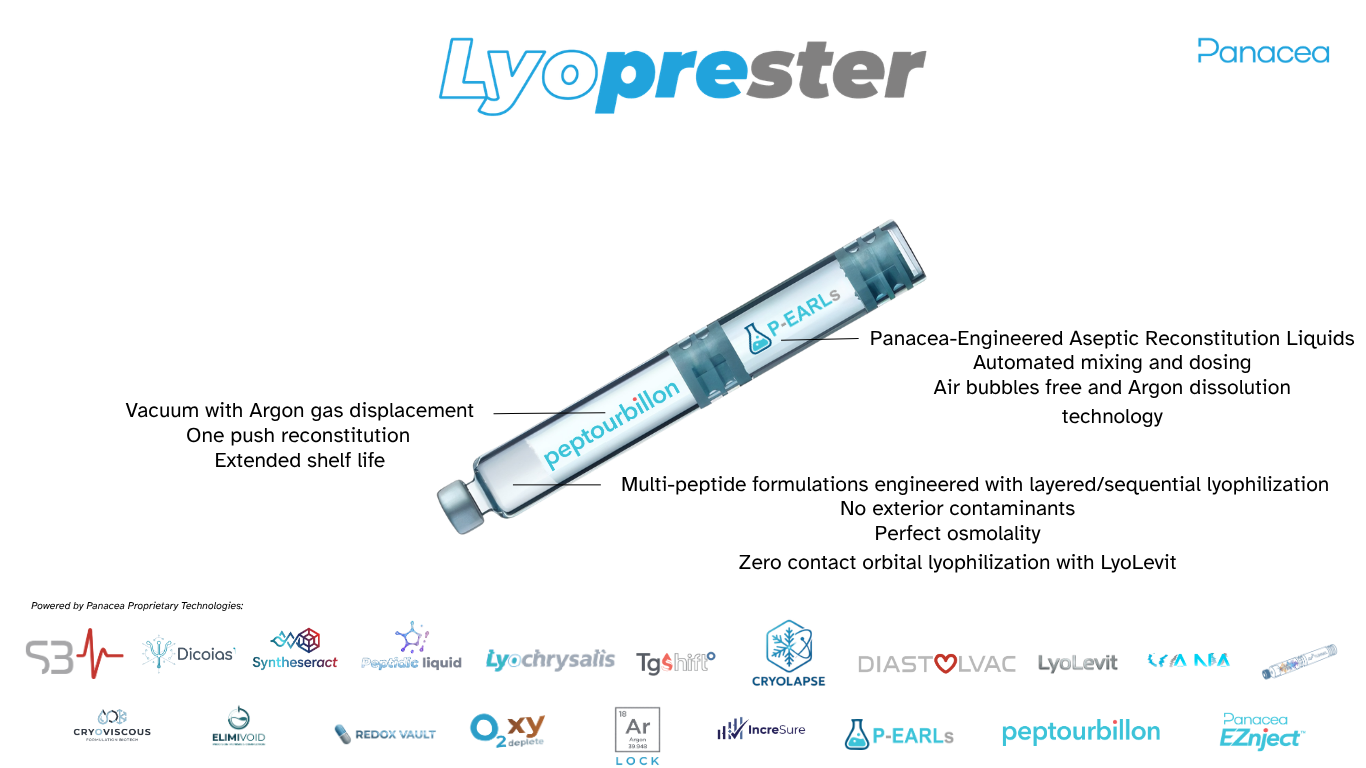
 Lyoprester®The only dual-chamber cartridge that is autoreconstitution-enabled, vacuum-sealed and argon-fillback.lyoprester.com ↗
 P-EARLs™Panacea-Engineered Aseptic Reconstitution Liquid(s) — each tuned to the peptide it wakes.p-earls.com ↗
 Peptourbillon™The layered peptide formulation architecture — single- or multi-layer, never a blend.peptourbillon.com ↗
 RF Tunnel™The RF-formed central channel through the cake.rftunnel.com ↗
 TgShift™Raises the cake’s glass-transition temperature with RF — instead of chilling below it.tgshift.com ↗
 Cryolapse™Cryogenic pressure collapse under S3Pulse™ control — vapour redistributed through the whole cake, not its surface, impeding crust formation.cryolapse.com ↗
 LyoLevit™The cake levitates and spins in high orbit — driven by ultrasound and RF.lyolevit.com ↗
 Lyochrysalis™The integrated chamber housing the whole drying stack.lyochrysalis.com ↗
 S3Pulse™The control brain for every piece of Panacea hardware.s3pulse.com ↗
 Liquiprester™The single-liquid cartridge engineered so multiple peptide APIs coexist in one shared vehicle.liquiprester.com ↗
 Syntheseract™Continuous-flow peptide synthesis in a special, very fast and economical way.syntheseract.com ↗
 CFSPPS™Continuous-flow solid-phase peptide synthesis, written as its own category.cfspps.com ↗
 OxyDeplete™Degassing plus no-headspace doctrine — the oxygen-starved seal.oxydeplete.com ↗
 ArgonLock™The final inert-atmosphere lock under argon.argonlock.com ↗
 RedoxVault™Separation, not merely suppression — redox isolation in lipid micro-reservoirs.redoxvault.com ↗
 PleniDose™The shared filling gantry — one machine filling both the dual-chamber Lyoprester and the liquid Liquiprester.plenidose.com ↗
 IncreSure™The dose-metrology layer — verified API per pen increment.incresure.com ↗
 ElimiVoid™Front-void elimination without touching the metered dose.elimivoid.com ↗
 Cryoviscous™The characterised cold, high-viscosity, low-mobility conditioning state.cryoviscous.com ↗
 Vana Machine™Vacuum–Argon–Nitrogen Architecture — draws the air and nitrogen out of the cake and backfills with argon; in a separate process, the same machine makes the P-EARLs bubble-free.www.vanamachine.com ↗
 EZnject™The disposable auto-injector pen built around the Lyoprester.panaceaeznject.com ↗
 Dicoias ΨThe computed-chemistry advisory — every substance reduced to a vector across physical, electronic and formulation space.dcppsi.com ↗
 SealoPrester™Aseptic Cartridge Closure System — Seal o’ Precision + Sterility.sealoprester.com ↗
 Peptidic LiquidThe peptide formulation in solution — the active plus its buffers, cryoprotectants, lyoprotectants and scaffolders.peptidicliquid.com ↗
 DiastolVAC™Biomimetic diastolic vacuum control — the pneumatic circulatory system of the machine: pumps, valves and sensors as one ensemble.diastolvac.com ↗
 KineticON™Motion Integrity Architecture — the motion-control layer that lets the machine know what happened on every axis move.kineticon.org ↗
The publications indexed in PubMed in the last 30 days for lyophilization primary drying temperature OR sublimation freeze-drying already appear in Trending above — the next most recent in the field, refreshed weekly.